
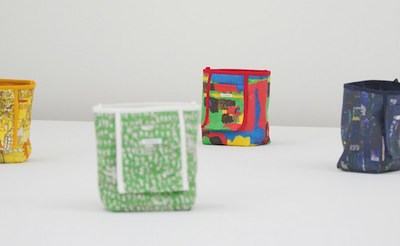

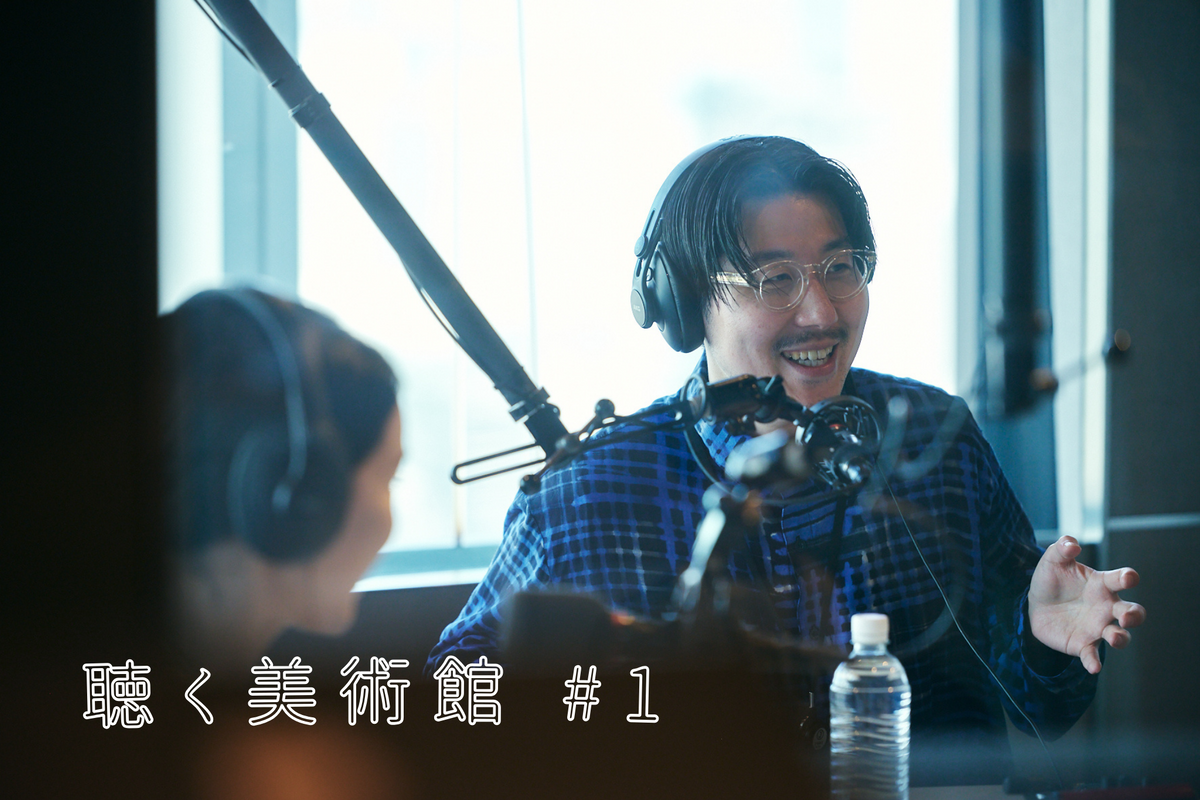

The secret story behind the birth of Heralbony, told by representatives Takaya Matsuda and Takafumi Matsuda. Podcast "Art Museum for Your Ears #1"
“HERALBONY TONE FROM MUSEUM ~A Museum You Can Hear~” is a podcast that focuses on the contracted artists of HERALBONY, a welfare experimental unit that launched this spring.
Actress, filmmaker, and writer Sara Ogawa and Takaya Matsuda, CEO of HERALBONY, will host the podcast, tuning into art to explore the personalities and life stories of the "exceptional artists" behind the works.
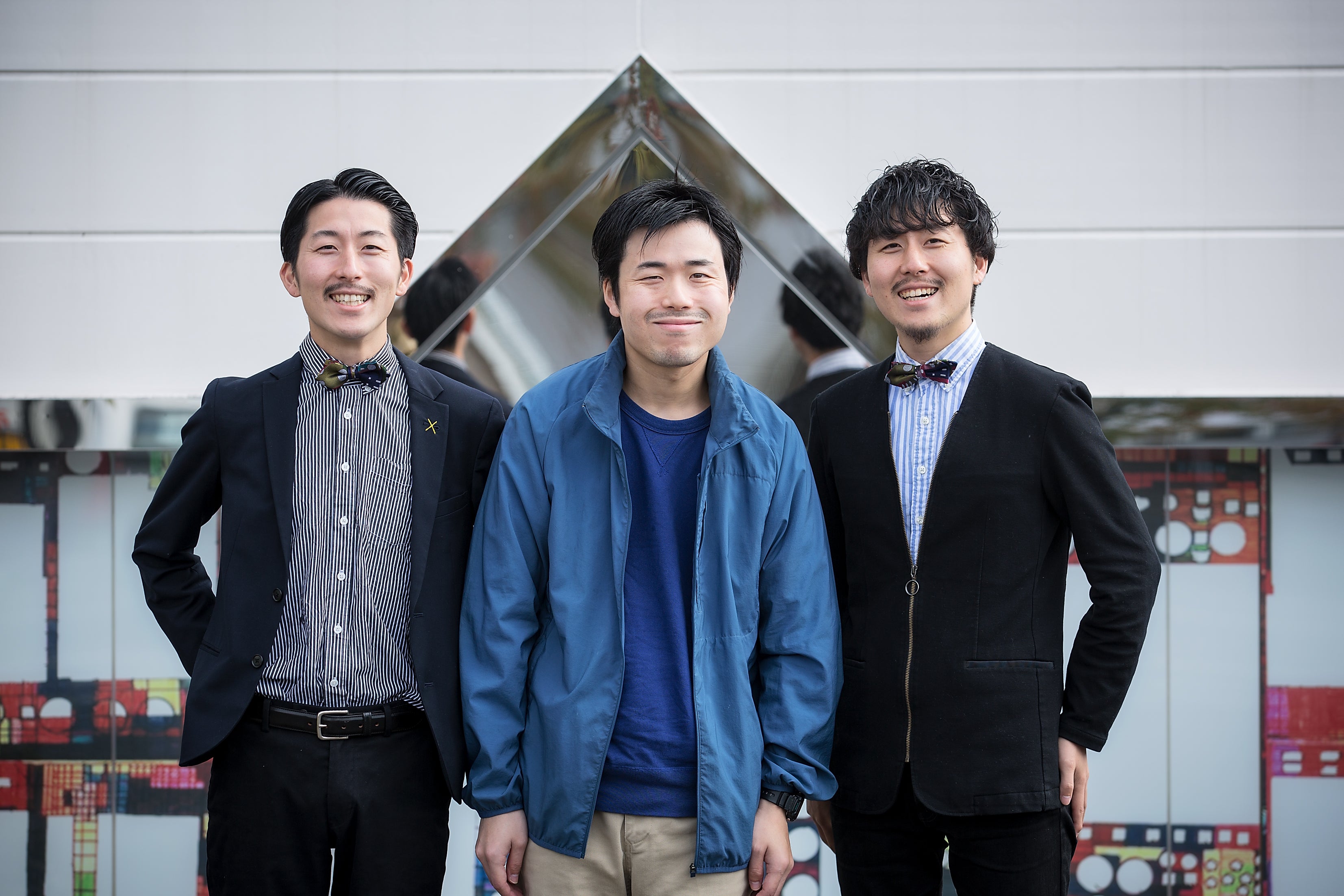
The theme of the記念すべき first episode is HERALBONY's history. Takaya himself spoke about how HERALBONY came to be, alongside his twin brother Fumito, who is the vice president.
# Not a Flaw, but a Feature
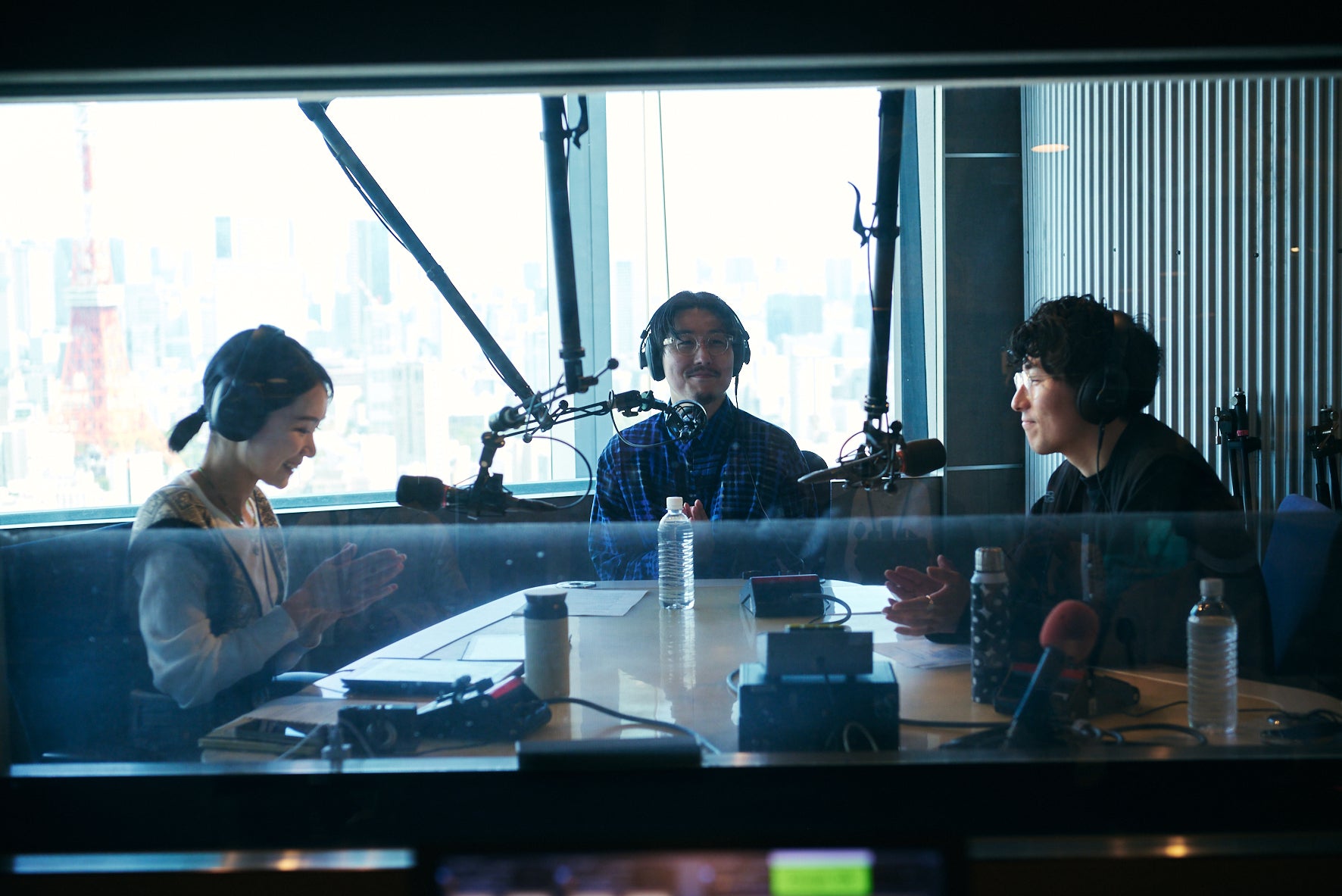
Ogawa Sara (hereinafter, Ogawa): Welcome to "TONE FROM MUSEUM," a podcast that focuses on the contracted artists of the welfare experimentation unit Heralbony. Hello, I'm Ogawa Sara. The記念べき first episode has begun! And let me introduce my partner.
Matsuda Takaya (hereinafter, Takaya): Nice to meet you. I'm Matsuda Takaya, the representative of Heralbony. We're starting this podcast, so please bear with us!
All: Nice to meet you. (Clapping)
Ogawa: So today, we also have one more person, Takaya's older brother, Fuminori. Fuminori is the vice president.
Matsuda Fuminori (hereinafter, Fuminori): Pleased to meet you! I'm Matsuda Fuminori, the vice representative of Heralbony, and I've come from Iwate. It's a pleasure to meet you!
Takaya: Fuminori lives in Iwate and came by Shinkansen today.
Ogawa: Is that so! Nice to meet you. You two are twins, aren't you? Well, it's obvious when you see you, though (laughs).
Takaya: That's right. Lately, people have been saying our voices are more similar than our faces. I wonder if it'll be okay on the radio (laughs).
Fuminori: Exactly!
Takaya: Well, I think it'll be the same no matter who speaks, so being a dynamic duo should be fine (laughs).
Ogawa: You're perfectly in sync, which is reassuring! Today, I'd like to start by asking "What is Heralbony?" Could you please tell us more specifically what kind of company Heralbony is?
Takaya: I'll start. There are a great many welfare facilities specializing in art throughout Japan.
Ogawa: Yes.
Takaya: Heralbony enters into license agreements with the artists there. Based on that art data, we apply it to various things, experiences, and places. The goal is that when you speak of "disability," you don't associate it with "lack" but with "difference" and "individuality," thereby increasing new options and possibilities. I believe it's a company that expands this way of thinking.
Ogawa: I see. So, the works of people with disabilities are turned into data and then into a wide range of artworks and goods, and they're all truly wonderful. I also looked at your website and was incredibly excited.
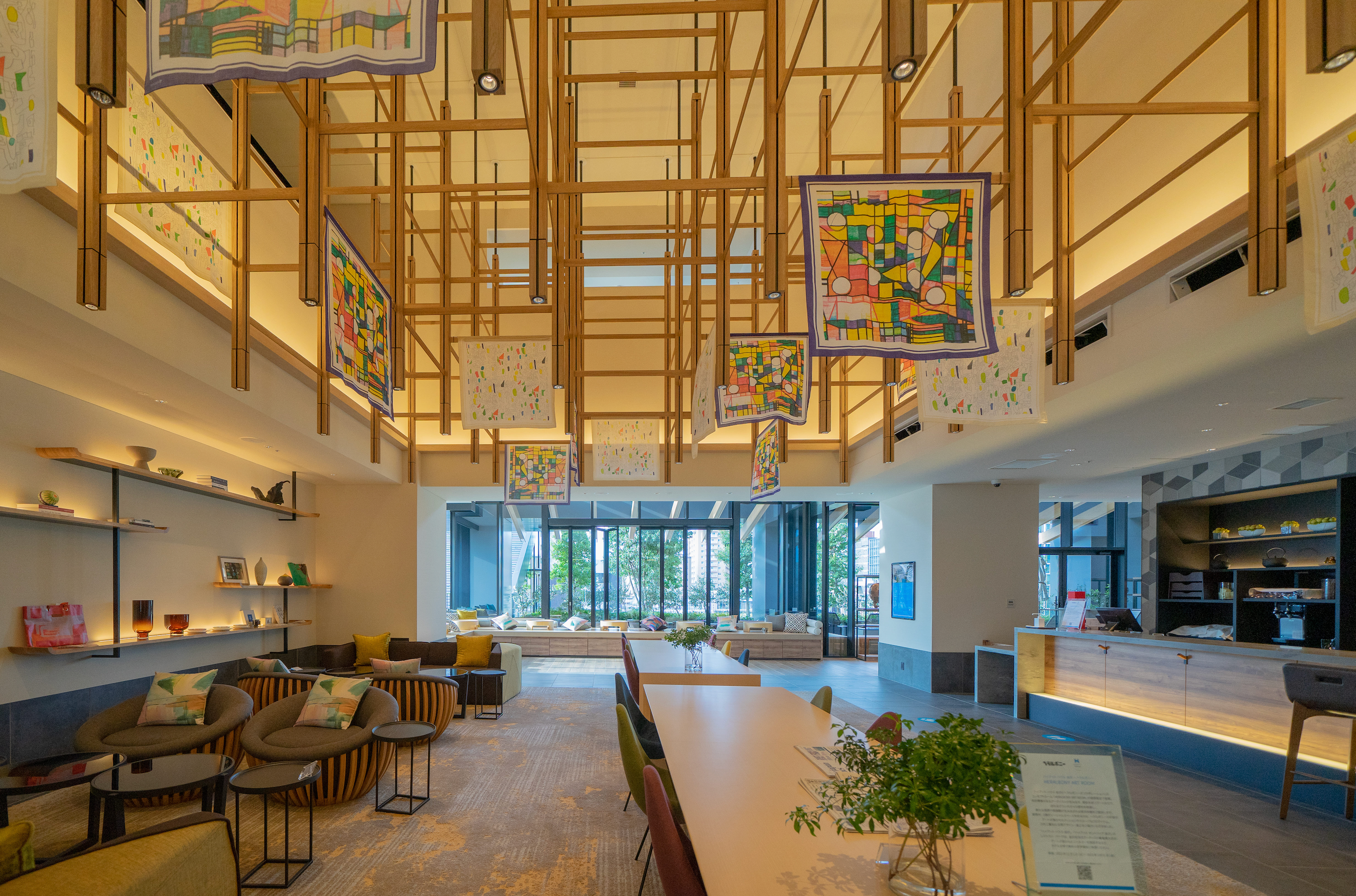
Takaya: I'm truly delighted. Even in our stores, we don't prominently display words like "disability" or "welfare." Similarly, when you visit the hotels we collaborate with, there aren't any captions indicating that. Our aim is to challenge perceptions by allowing people to appreciate the beauty purely for what it is, and then, if they happen to realize that these are drawings by people with intellectual disabilities, that awareness will spread. That's why Monto and I, as twins, started this project.
Monto: Yeah.
# My Brother's Notebook

Ogawa: So, what was the original impetus for starting this initiative at this company?
Takaya: The impetus was, well, my twin brother and I have an older brother, Shota, who is four years our senior. He has severe intellectual disabilities accompanied by autism, so disability has been a part of our lives since birth. My brother does some interesting movements and actions. For example, lately, he's really into "Sumo wrestler Sanoyama."
Ogawa: Oh!
Takaya: He seems to like the sound of "Sumo wrestler Sanoyama!"
Fumito: Like the pleasing sound of it. Also, I came here by Shinkansen today, and whenever he sees a Shinkansen, we all have to say "Shinkansen!" as a family.
Ogawa: You all say it?
Fumito: Yeah, yeah. But Takaya, you don't say it, do you?
Takaya: I say it too (laughs)! My brother has all these interesting quirks, but when he makes loud noises on the train, people tend to pull away, or at school, he gets imitated a lot by his classmates. As I saw these situations unfold, I developed a strong interest in changing the perception of intellectual disability.
Ogawa: I heard that the company name "Heralbony" was also inspired by your older brother, Shota. Can you tell me about that?
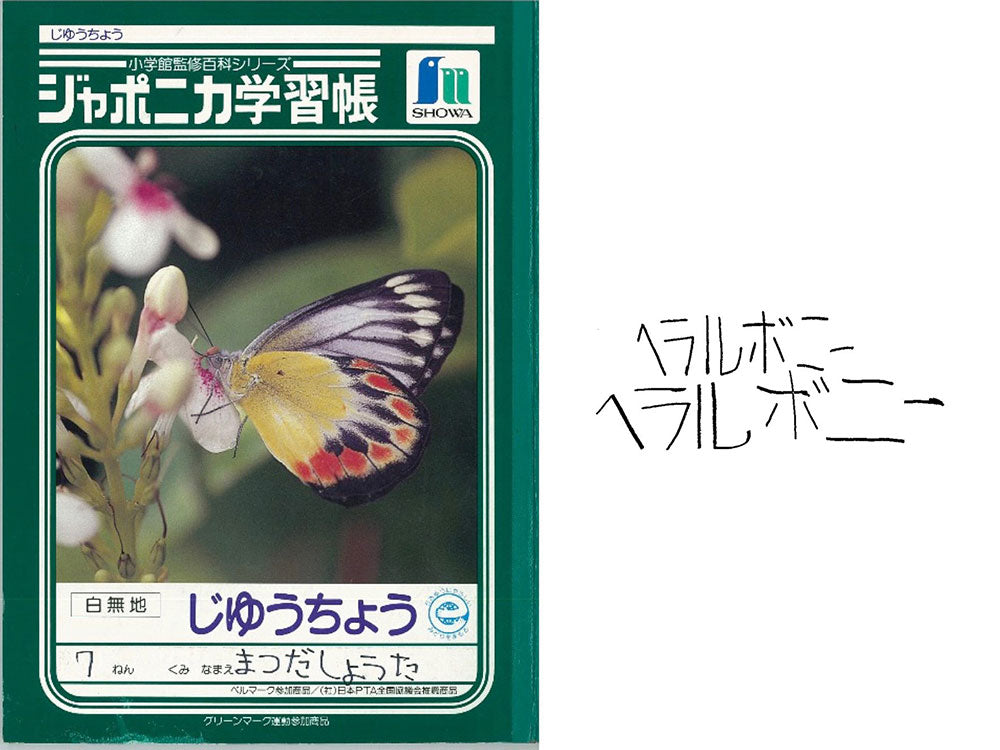
Takaya: Thank you. The company name "Heralbony" comes from a mysterious word my brother wrote countless times in his diaries and notebooks when he was in elementary school. When I was around 20, just like Sara-san, I also wanted to dedicate myself to filmmaking. I went back to my parents' house, looking for traces of my brother to find a theme for my films. Then, I found a pile of notebooks and diaries.
Bunto: Hmm.
Takaya: Back then, my brother was obsessed with the TV phrase "This program is brought to you by the following sponsors." So, his diaries and notebooks were full of logos. As I was looking through them, I found a mysterious phrase, "Heralbony Heralbony," appearing in various places, nestled among the logos.
Ogawa: Have you ever asked Shota what it means?
Takaya: My brother said, "I don't know!" My mom didn't know either, and searching online yielded zero results. So, I always thought it would be great if I could turn this word into something someday. But when I told Fumito, "Let's name the company Heralbony," he said, "That's lame!" (laughs).
Fumito: I didn't say it that strongly (laughs)!
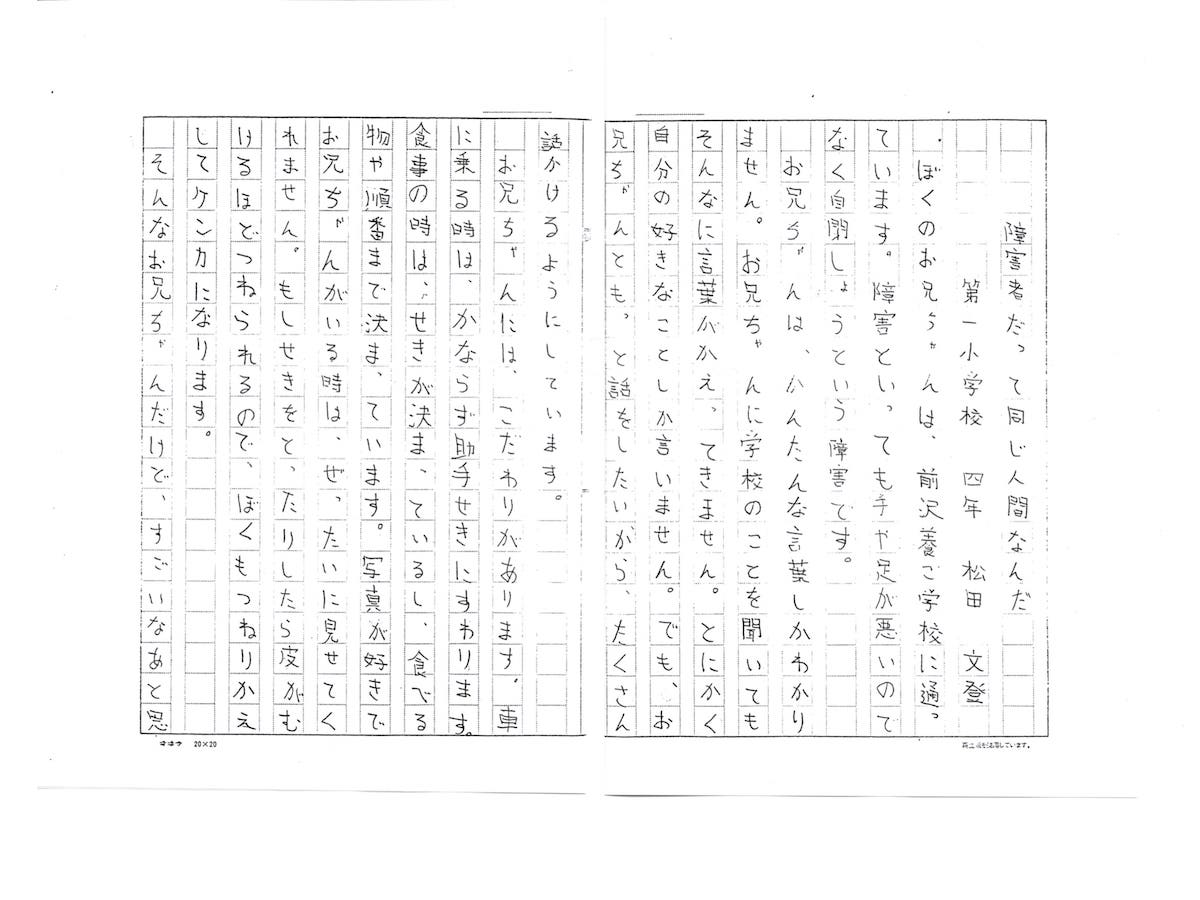
Ogawa: So, at first, Fumito was puzzled by the word "Heralbony" (laughs), but it just so happens that we have an essay he wrote when he was in the fourth grade today.
Fumito: Thank you.
Ogawa: It's a wonderful essay, so would it be alright if I read a little bit of it?
Takaya: Please do.
-------
“People with disabilities are human beings, just like us.”
Fumito Matsuda, Daiichi Elementary School
My older brother attends Maesawa School for Children with Special Needs.
His disability isn't with his hands or feet; it's autism. My brother only understands simple words. When I ask him about school, he doesn't say much. He only talks about what he likes, no matter what. But I want to talk to him more, so I try to speak to him a lot.
My brother has certain fixations. When we get in the car, he always sits in the passenger seat. At meal times, his seat is fixed, and even what he eats and the order are decided. He likes photos, but when he's around, he absolutely won't let me see them. If I take his seat, he'll pinch me until my skin peels off, so I pinch him back, and it turns into a fight. But even though he's like that, there are things about him that I think are amazing.
First, he helps out. My brother cleans the bath all by himself. I think it's such a chore, but he works hard at it. He washes the dishes with Mom. We three siblings hang the laundry.
Second, he writes in his diary every day. From my perspective, he only writes about four lines, but he's trying his best in his own way.
Every time Mom reads his diary,
"Yes, you did well," she says with a smile, and my brother says,
"Finished."
He says, and claps his hands with joy.
Third, he walks two or three kilometers to the station by himself and takes the train to Maesawa School for Children with Special Needs. This happened when I saw his class's play at the learning exhibition last year. My brother and another person played the pianica together, and it was so good. He doesn't practice at home at all, so I thought it was amazing that he could do that just at school.
There's something that always bothers me. When we go to department stores or restaurants, people stare at my brother. Little kids say about my brother,
"He's strange."
I tell that child,
"He has a disability, so it can't be helped, right?" But they don't understand.
When we went to the pool with the "Yuyu no Kai," a gathering for people with disabilities that my brother belongs to, a boy about my age pointed and laughed at my brother and the others, and I felt angry as if it were happening to me.
At times like these, I always think:
"People with disabilities are human beings, just like us."
I want them to be seen as normal, just like us.
-------
Ogawa: So, this is wonderful...
(Everyone applauds)
Takaya: It’s so wonderful, it’s hard to believe Bunto wrote it.
Bunto: Hey!
Ogawa: First of all, isn't it incredibly well-written for a fourth grader?
Takaya: No, no, it really is.
Bunto: I was surprised myself.
Ogawa: Bunto, you wrote this (composition), and I'm sure there was a reaction in the classroom, but I wonder how your mothers felt when they read it.
Bunto: Indeed, I wonder how they felt? I bet they were happy.
Takaya: It was published in brochures for organizations of people with disabilities in Iwate Prefecture, right?
Bunto: Was it? I might not remember (laughs).
Ogawa: It's wonderful that it was kept so carefully, and that these feelings are connected to your current activities.
Bunto: Yes, that's right. I certainly still have various feelings, but rather than loudly saying "Don't discriminate or be prejudiced" against people with disabilities, I think it's better to create encounters with society through the beautiful filter of art, which can lead to gradual changes, and if it becomes one of the beautiful functions of enlightenment, that would be great. I still feel that way.
Ogawa: Now that you're raising children yourselves, what do you think about your own parents' parenting? How did your parents treat you three siblings?
Takaya: I think they allowed us to challenge ourselves. And regarding disability, my mother had a very strong belief that "it's not something to hide." So, when we were in elementary school, my brother would naturally join in and play with all our friends.
However, when we entered junior high school, the differences started to be mocked. For example, in my junior high school, the word "supe" became very popular. It was an abbreviation of "autism spectrum." Like "stupid" or "idiot," if you got a bad score on a test, you'd be asked, "Aren't you a supe?"
At that time, my twin and I found it very difficult to say that our brother had an intellectual disability. But our mother still had a strong belief that "disability is not something to hide," so she would bring my brother to sports days and club activities. When that happened, my twin and I strongly didn't want our brother to be seen, and there were times we wouldn't go back for lunch on sports days. And then our mother would get angry and go home. I remember those difficulties during junior high school.
# Lallanbien Gallery
Takaya: At first, I really wanted to target my local friends. I'm from a town of 10,000 people in Iwate, but even if I were to combine the words "welfare" and "art" and deliver it to my local friends with a bang, for them, welfare honestly isn't relevant, and honestly, art isn't either; there's almost no one around me in Iwate who buys art.
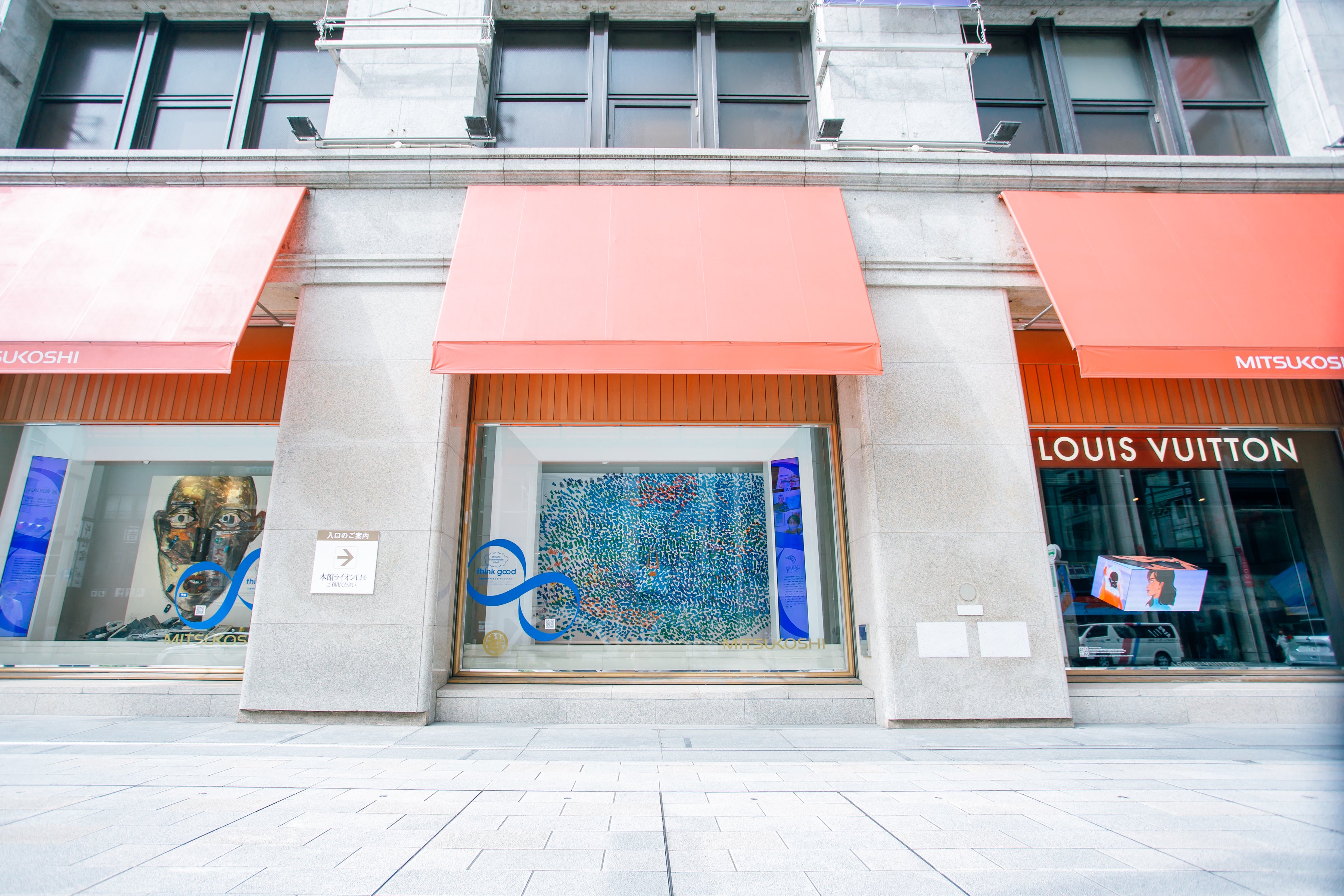
Takaya: When I thought about Iwate, I realized that my local friends really aspire to certain brands, like, "If I had a car, I'd want to drive this brand," or "If I were going to a department store, I'd want to go to one like this." I thought that by including welfare and art under the umbrella of a brand, my local friends might start saying, "That's cool!" I remember thinking that might be possible, and that's why I decided to make it a brand. It feels very nostalgic to think about now.
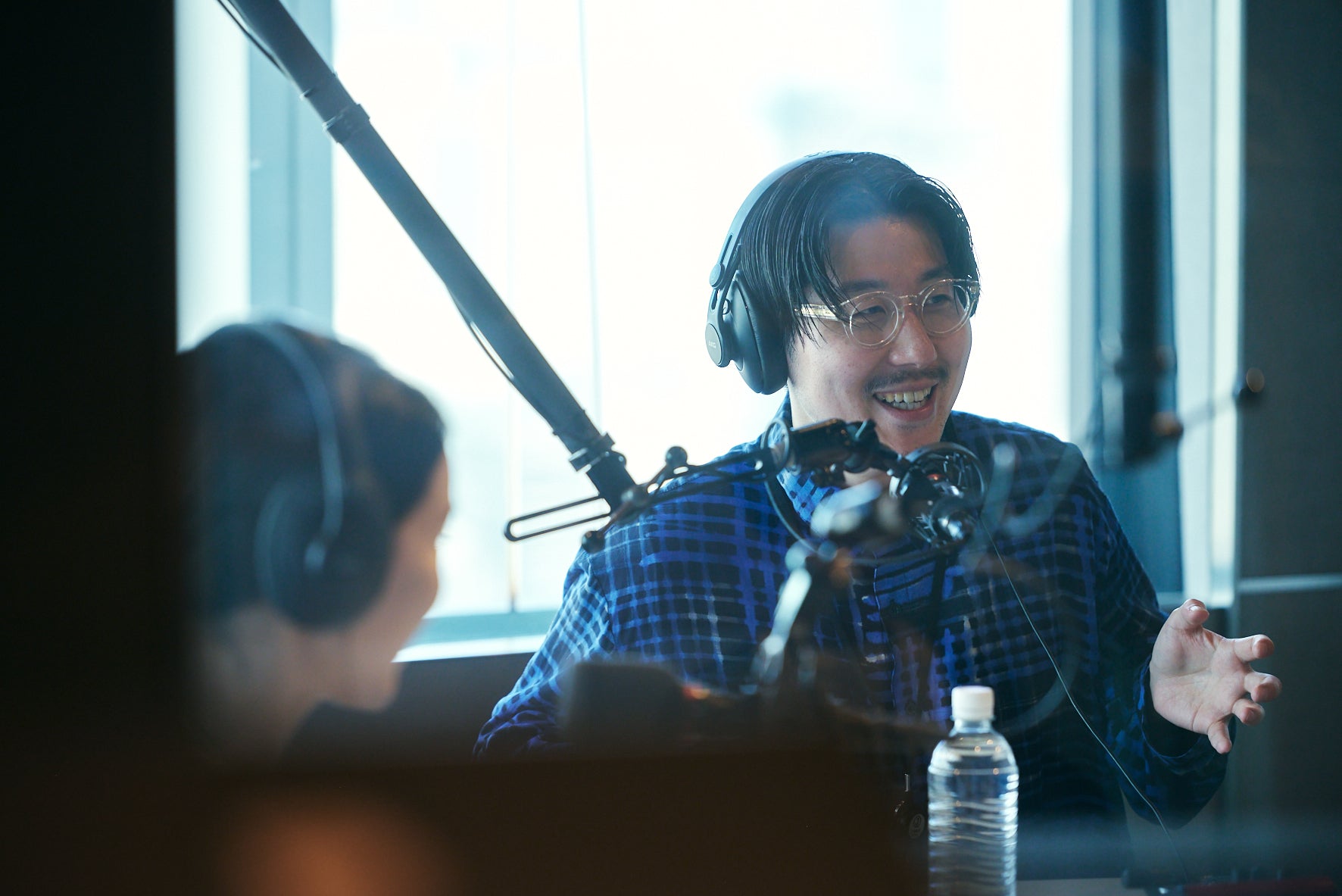
Ogawa: I think it's wonderful that you thought of the local people and aimed to deliver to them. I heard that when you were 24, you visited the Lulunbini Museum in Iwate Prefecture. What happened there?
Fumito: It was Takaya who went first, right?
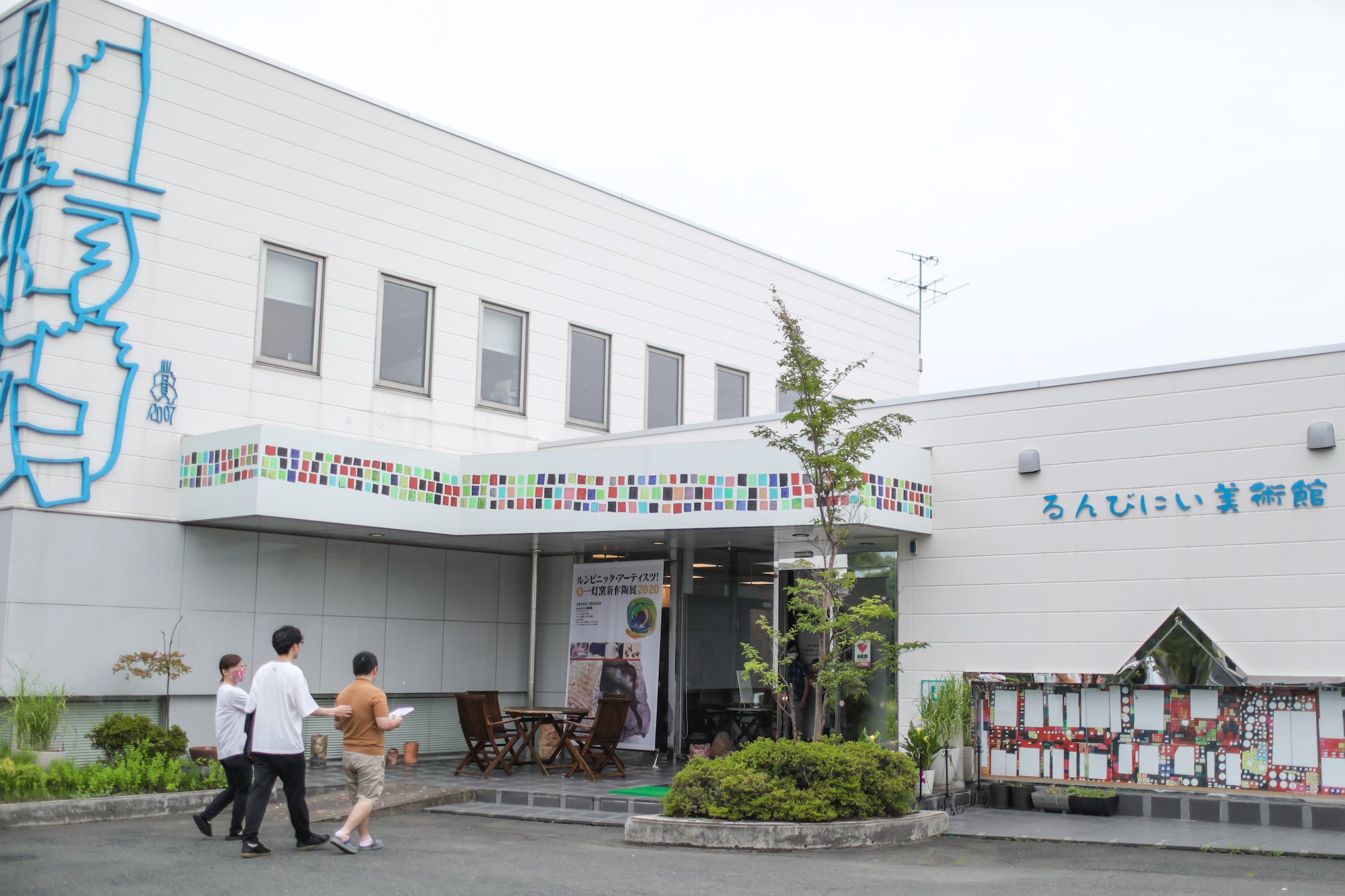
Takaya: Yeah. I was working in Tokyo, and when I went back (to Iwate) for Obon when I was 24, my mother said, "There's a museum called Lulunbini Museum in Hanamaki City, Iwate Prefecture, that displays art drawn by people with disabilities. Would you like to go, Takaya?" I thought that sounded really interesting.
Fumito: Why wasn't I invited, I wonder now (laughs).
Takaya: (Laughs). I think you were working and hadn't come back. So I went to the Lulunbini Museum, and there were so many artworks lined up, like a piece with endless black circles drawn with a ballpoint pen, and another with a jumble of red and blue colors drawn with brush markers. I was intensely moved by how cool they were, so I called Fumito, my twin brother, and told him that there was this amazing world out there and that we should try to do something, anything. I think that phone call was the very beginning of Heralbony.
Takaya: If you search for "disability art," even now, you'll often find situations where a disability art exhibition is held in a corner of a city hall, next to drawings by preschool children. What I thought was that there's really no need to change the artists themselves. It's not about educating them or anything so presumptuous. It's simply that their work is truly wonderful. If we can just take that wonderful work and present it in a wonderful place, output it to the world in a wonderful state, then even within this capitalist economy, we can create a mechanism for proper economic circulation. I remember thinking that.
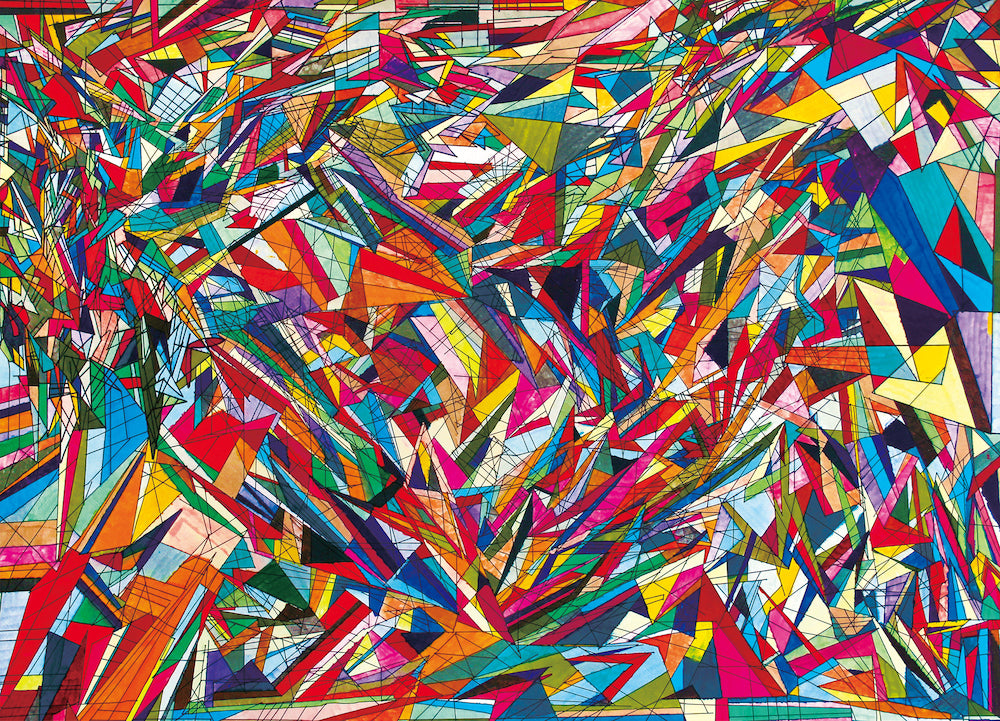
Michiyo Yaegashi "Origami"
Ogawa: The term "Art Brut" itself is gradually emerging as art by people with disabilities, but do you have any thoughts on that?
Bunto: The term "Art Brut" itself, especially in Japan, is sometimes referred to as "Japanese-made Art Brut," but in reality, overseas, "Art Brut" is a general term for "art by people who have received no artistic education whatsoever." In Japan, however, it has become "art by people with disabilities = Art Brut," which is the current situation. So, from an overseas perspective, there's a feeling that Japan's "Art Brut" might have a slightly different value system.
Ogawa: I see.
Bunto: So, for me, there are various names for art by people with disabilities, such as "Art Brut" and "Outsider Art," but more than just deciding what to call them, I think there's a way that we, as a private company, can truly break through the values and things that the artists want to convey through their works. I hope that a new concept will emerge from that.
Ogawa: With those thoughts, the gears have started to turn, and I'd like to hear more about this in detail in the next session. Thank you very much!
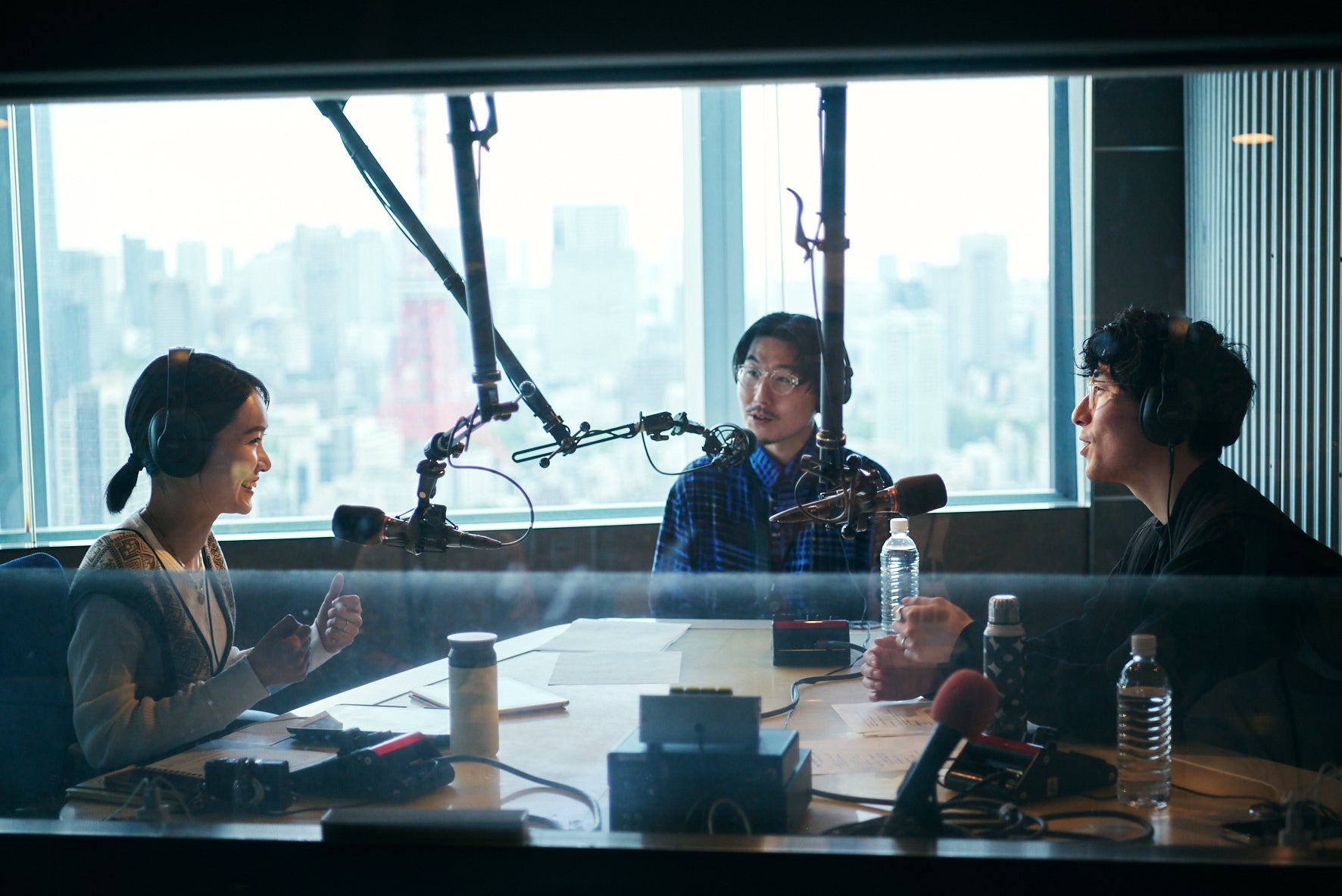
text Chise Akasaka/photo Jozo Suzuki
Podcast "HERALBONY TONE FROM MUSEUM ~Museum for Your Ears~" now available for free streaming.
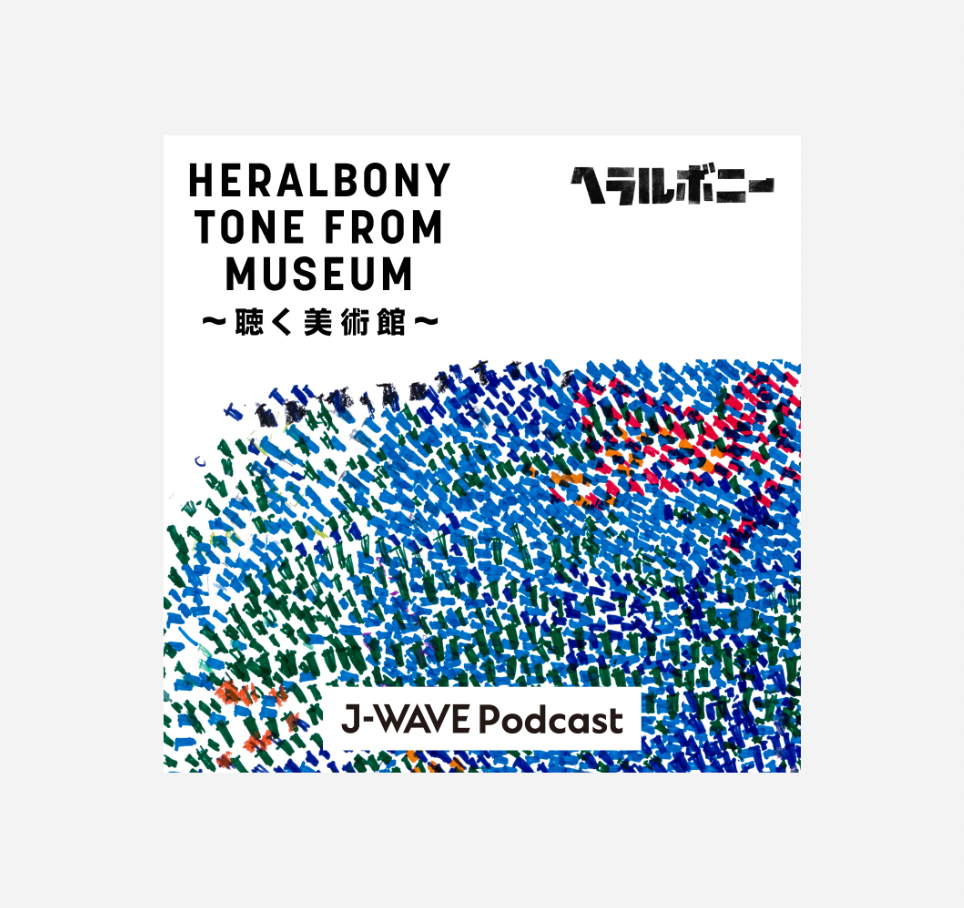
This program, based on the concept of "The History of Unique Artists Imagined from Art," delves into the personalities and life stories of "unique artists" through their works, by listening carefully to the art itself.
The program is hosted by Sara Ogawa, an actress, filmmaker, and writer, and Takaya Matsuda, Representative Director and President of Heralbony. Each episode features one Heralbony contracted artist, and we welcome the artist with intellectual disabilities, their family members, and staff from welfare facilities as guests.
New episodes are distributed every Sunday on Apple Podcasts, Google Podcasts, Spotify, and Amazon Music.
Past episodes are also available for free.