


Artist Takuma Hayakawa, who loves trains and idols, expresses his condensed "love" in this piece. "Art Museum for the Ears #4"
Heralbony Tone From Museum: The Listening Museum is a podcast that focuses on the contracted artists of Heralbony, a welfare experimental unit launched this spring.
Actress, filmmaker, and writer Sara Ogawa and Heralbony CEO Takaya Matsuda serve as hosts, listening to the art and exploring the personality and life story of the "exceptional artist" visible beyond their works.
The guest for the fourth episode is exceptional artist Takuma Hayakawa. Hayakawa, an award-winning artist, creates works that are filled with condensed "love" that overwhelm viewers.
#FillMyLifeWithThingsILove
Takaya Matsuda (hereafter, Takaya): Today, we bring you artist Takuma Hayakawa from Matsusaka City, Mie Prefecture. Sara, first, this is one of Mr. Hayakawa's works, but can you tell what is depicted?
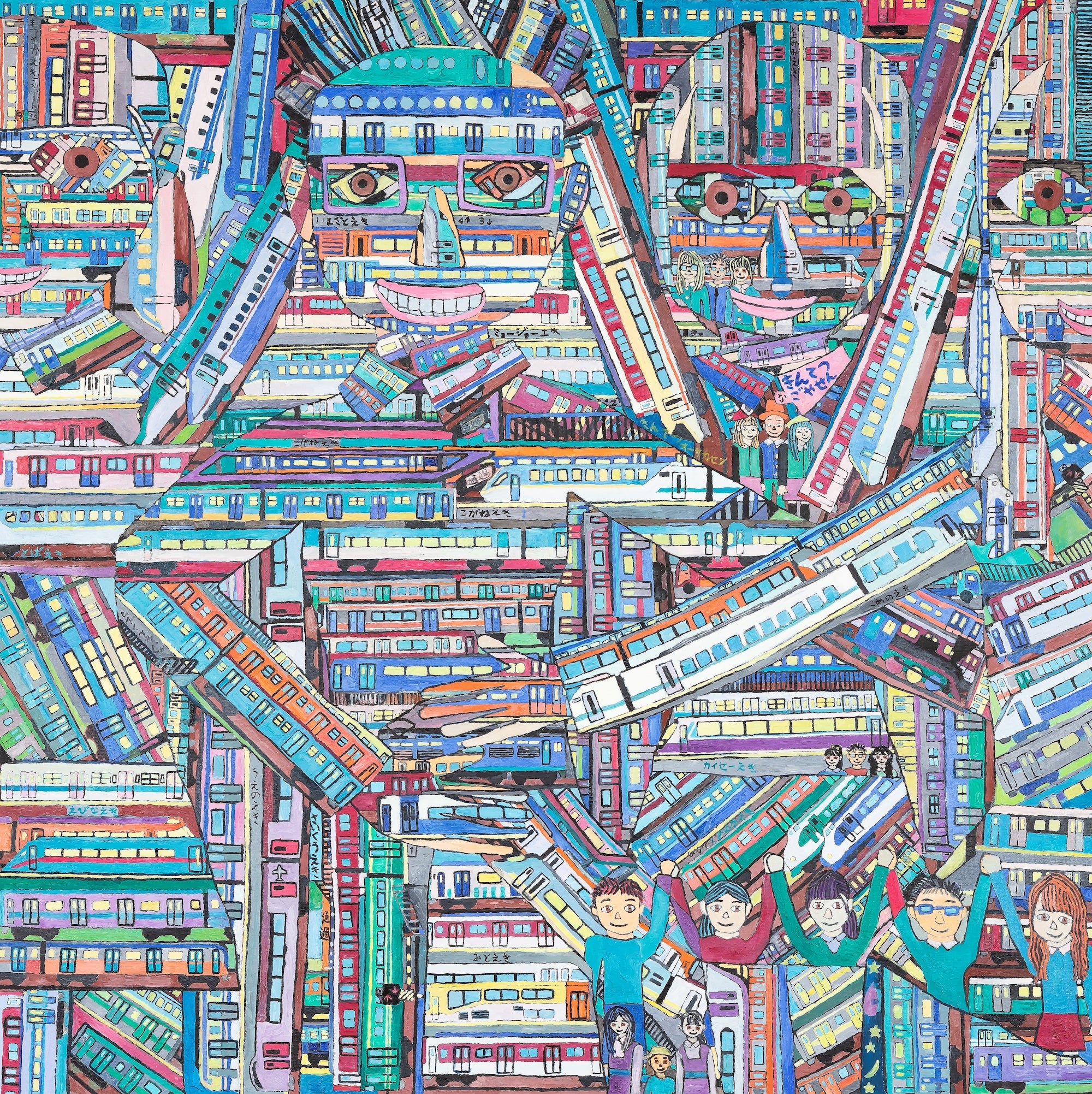
Takuma Hayakawa "Dancing Passing Train"
Sara Ogawa (hereafter, Ogawa): This is amazing! So many things are drawn with incredible precision, but these are trains, aren't they?
Takaya: Exactly! The trains are spread out in every direction, and can't you see a faint outline within them?
Ogawa: Oh! If you look closely, there are human figures!
Takaya: Exactly as you said. Within the sprawling lines of the painting, there are human outlines. There's a man in the center, and I think the people on either side of him appear to be women.
Ogawa: I'm curious about who this person is and who the people around them are.
Takaya: Doesn't it look like the man is shaking hands with the women next to him?
Ogawa: Indeed, their hands are overlapping.
Takaya: That's right. Actually, the man in the center is Mr. Hayakawa himself, and the women he's shaking hands with are actually idols.
Ogawa: Idols?
Takaya: Yes. He is intensely fond of trains and idols, and he appears in his own paintings, shaking hands with idols while being surrounded by trains. He draws these types of works with incredible precision. We often exhibit Mr. Hayakawa's works at contemporary art galleries, and they can be traded for sums in the millions of yen. We have invited such a highly acclaimed artist here today.
Ogawa: Wow. Mr. Hayakawa is an artist affiliated with "Kibouno Sono" in Mie Prefecture, isn't he?
Takaya: That's right. Today, we also have Mr. Murabayashi, the director of "Kibouno Sono," joining us. "Kibouno Sono" is a welfare facility nestled among rice paddies and even Matsusaka beef cows, and Mr. Hayakawa is based in the studio there.
Ogawa: So, today we welcome Takuma Hayakawa and Mr. Murabayashi online! Hello!
Mr. Hayakawa: Hello!
Director Murabayashi: Hello!
Takaya: Nice to meet you.
Mr. Hayakawa: Nice to meet you.
Ogawa: I just saw your artwork, Mr. Hayakawa, and you really love trains and idols!
Director Murabayashi: Do you like them?
Mr. Hayakawa: Yes! I love them.
Takaya: You love them.
Mr. Hayakawa: I love trains.
Takaya: That's great! Why did you come to love trains?
Mr. Hayakawa: I want to see trains! There's a Romancecar Museum!
Takaya: Romancecar! Actually, JR East is a shareholder of Heralbony.
Ogawa: Oh!
Takaya: So, I thought about asking Mr. Hayakawa if he could draw a picture of JR East's trains. Then he said he also really loves other railway companies. Since there were other competitors, I couldn't make the request at that time. I apologize for letting my personal desires get in the way (laughs).
Ogawa: So you broadly love trains. Mr. Hayakawa, what do you like about trains?
Mr. Hayakawa: About trains?
Director Murabayashi: Yes. Why do you like trains?
Mr. Hayakawa: (Forcefully) I want to go to the Romancecar Museum.
Mr. Murabayashi: Mr. Hayakawa also really loves to travel, you know.
Ogawa: Oh really!
Director Murabayashi: He probably has a strong curiosity to go to places he hasn't been before, or to see things he hasn't seen. It might be that trains are something that can transport him to such places.
Takaya: And you always go out to various places with your mother, don't you? Thank you for coming to Heralbony's exhibition in Tokyo the other day.
Ogawa: Looking at this train painting, I was curious, how do you usually draw?
Director Murabayashi: When there's something he wants to draw, he first draws the outline, and then he fills it in with trains. As a result, he creates figures made of trains, or landscapes made of trains.
Ogawa: Oh, so that's how you draw.
Director Murabayashi: He draws the shape of an idol he likes, a favorite person, or a landscape he saw during his travels, and then fills it in with trains.
Ogawa: So you fill what you like with what you like, that's wonderful. By the way, who are your favorite idols?
Mr. Hayakawa: Idols? Do you like idols? Which idol?
Director Murabayashi: Who's your favorite idol?
Mr. Hayakawa: Which idol? Which idol?... Nogizaka46.
Takaya: And among them, who do you like?
Mr. Hayakawa: There is.
Mr. Murabayashi: Who?
Mr. Hayakawa: (Carefully) Ayame Tsutsui!
Takaya: Ohh~! Do you go to events?
Director Murabayashi: When there's an exhibition in Tokyo, he goes to the AKB48 Theater in Akihabara.
Takaya: Speaking of which, when a TV station covered our exhibition at Nagoya Mitsukoshi, they asked Mr. Hayakawa "where would you want to go if your artwork sold," and he said, "I'd go to a handshake event!"
Ogawa: Oh really~!
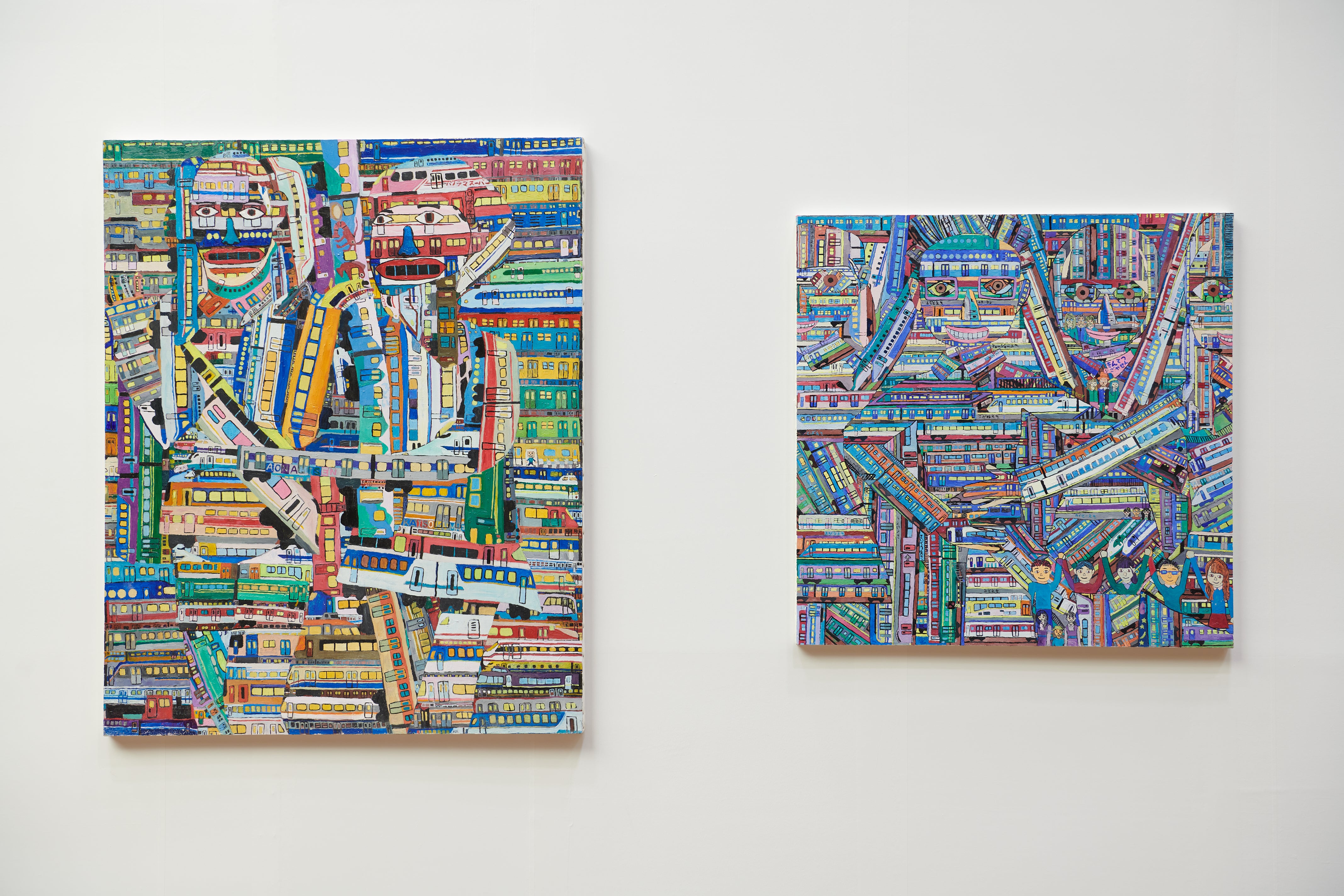
(Left) "Poses of Many Passing Trains" (Right) "Passing Trains Dancing"
Takaya: Not long ago, one of your original drawings sold for about 1.8 million yen on Heralbony. Mr. Hayakawa, did you do anything with that money?
Murabayashi (Director): You're making money, aren't you?
All: (Laughs)
Muramatsu (Director): What are you spending it on? Did you go anywhere? A trip, maybe?
Mr. Hayakawa: (In an excited tone) The Romancecar Museum.
Takaya: You really love the Romancecar Museum! I want to go too.
Mr. Hayakawa: I love it.
Takaya: That's great! Where is it?
Mr. Hayakawa: The Romancecar Museum? It's at Ebina Station.
Ogawa: Mr. Hayakawa, have you ever ridden the Romancecar?
Mr. Hayakawa: The Romancecar?
Murabayashi (Director): Yes, yes. In fact, you rode it with me! You were so happy and excited then. I think it was when we went to a small private train museum in Machida, wasn't it?
Mr. Hayakawa: Machida? Train?
Murabayashi (Director): Oh, Mr. Hayakawa, you seem nervous.
Ogawa: Oh dear. Mr. Hayakawa, are you all right?
Mr. Hayakawa: ...Yes!
Murabayashi: Heh heh. It's because Ms. Ogawa is so cute. Alright, now look at your older sister's face (laughs).
Ogawa: Ahaha!
Takaya: Someday, it might be nice if you could shake hands directly with Sara-san. With your mother too.
Ogawa: You're right. I'd love for you to come to the studio.
Mr. Hayakawa: (Happily) Handshake? A handshake event?
Ogawa: Yes! I look forward to it (laughs).
#DrawFromABirdsEyeView
Ogawa: Hayakawa-san, have you always drawn like this?
Hayakawa: Since when? Atelier? Since when?... When I was in elementary school. First grade.
Murabayashi (Director): It seems he's been drawing ever since he was old enough to know what was going on. His elementary school teacher brought him to the atelier because he was very good and always drawing. I think he was around third grade then?
Takaya: Oh, wow.
Ogawa: Did you draw things you liked, like trains, back then too?
Murabayashi (Director): Yes, he did. He used to draw trains and animals on drawing paper with watercolors.
Takaya: So it was watercolors! I bet it was a different world back then, wasn't it?
Murabayashi (Director): Yes, it was. He also drew flowers.
Ogawa: Oh, that's lovely. By the way, what do you use to draw now?
Murabayashi (Director): What do you use now?
Hayakawa: What do I use?... Oil paints.
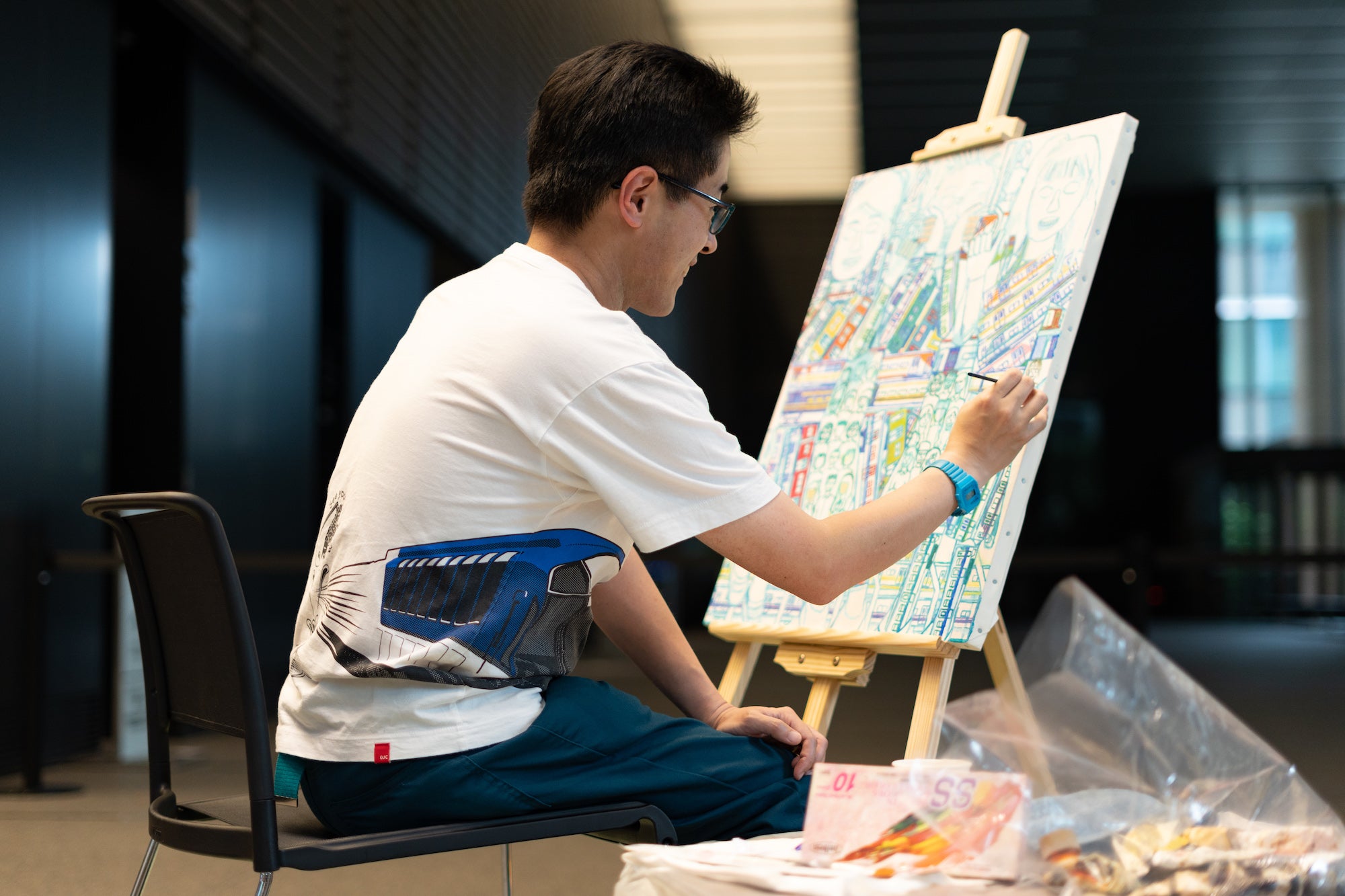
Ogawa: Wow, that's amazing.
Takaya: I've also seen Hayakawa's early works, and while his style is the same now as it was then, I've noticed that his artistic skill has really improved. When you first met Hayakawa, Director Murabayashi, how did you perceive him?
Director Murabayashi: When he first came to the atelier, he said, "I'm going to draw a memory of my family going skiing." He drew a scene on paper of his family of three on a lift, from directly above. In other words, it was an overhead view, with the tops of their round heads and then their shoulders drawn from there, and I thought that was amazing. He doesn't draw from his own perspective, but draws the scenery he's in.
Ogawa: Indeed, in his current works, he himself exists within the world of trains, doesn't he? It's possible that the scenery Hayakawa always sees is a bit unique and has an overhead, panoramic quality to it.
Director Murabayashi: Yes, that's right. At first, he used to draw idol girls and trains separately, but I think it's been about 10 years now? He started drawing idols with the trains themselves, mixing the things he liked together.
Ogawa: I see. Hayakawa, how do you spend your day?
Director Murabayashi: Hayakawa, what time is your pickup?
Hayakawa: Pickup? ...Bus pickup? ...Kibō-no-Sono? 9:15.
Director Murabayashi: That's right. First, we pick him up in the morning, and he does light work at the facility, like peeling black garlic. After that, he draws pictures all the way until 3 PM.
Takaya: Hayakawa's works are sometimes drawn on a 2-meter scale, so it can take about a year to complete one piece, I hear.
Ogawa: Indeed, if you're going to draw so many intricate trains, it must take a considerable amount of time.
# "Mr. Ota from Heralbony"
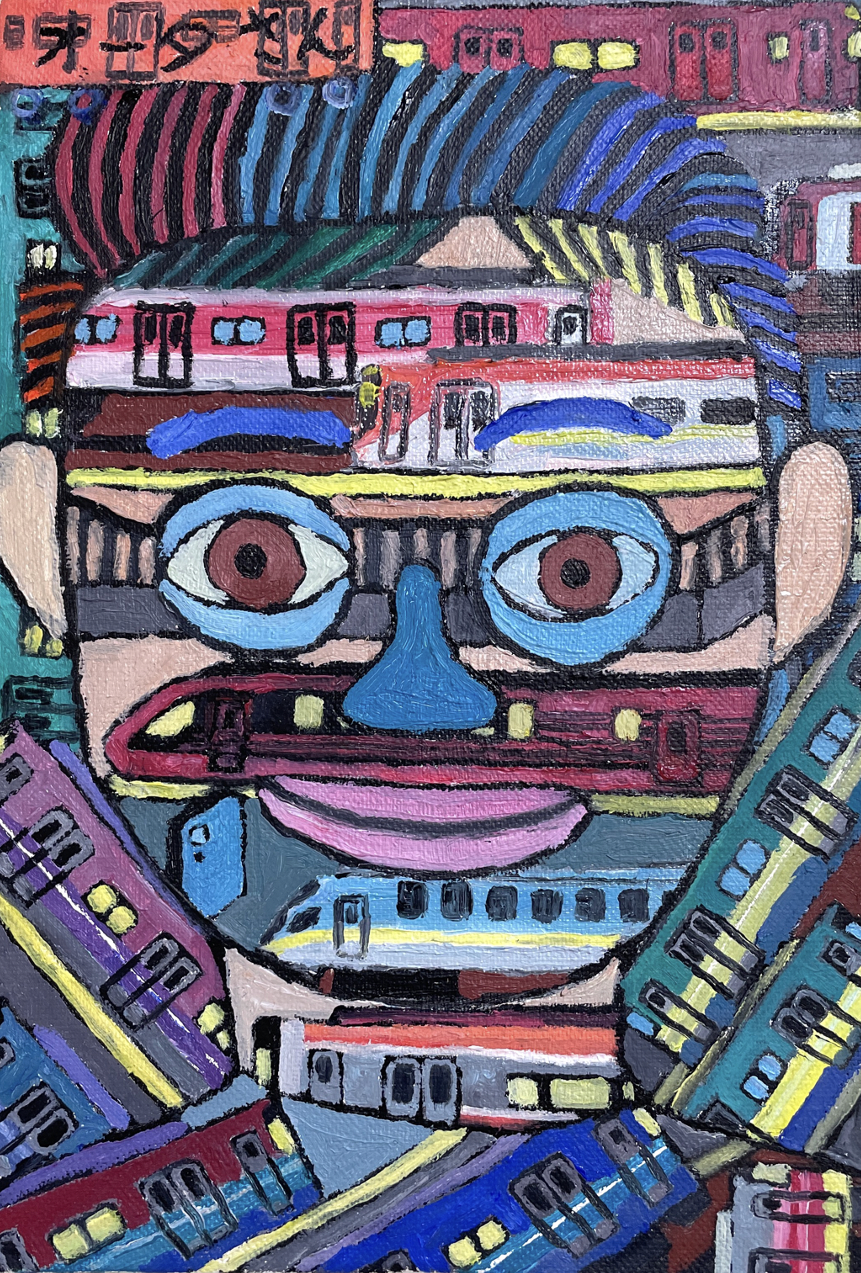
Ogawa: Is this person Ota-san?
Takaya: That's right. Hayakawa-san drew it for me, and Ota was really happy about it. Hayakawa-san, do you remember Ota-san?
Hayakawa-san: Ota-san? Of course, I know him!
Ogawa: What a huge smile!
Takaya: In past interview articles, he even introduced him as his friend, Ota-san. However, Ota-san is currently hospitalized with appendicitis. He's about to be discharged, but if it's alright, I'd appreciate it if you could give him some words of encouragement.
Murabayashi (Director): Ota-san, I heard you're sick. Go say something to him?
Hayakawa-san: Ota-san? Sick? ...Oh, that's a shame...
Everyone: Bursts into laughter
Takaya: So casual! That's great! No, but he'll really be happy. He even sent me a selfie from his hospital room, so I'll send it to you later.
Murabayashi (Director): In the pre-interview questionnaire we received for this interview, under the item "What do you like?", you wrote "Yunosuke Ota."
Ogawa: Just now, the moment Ota-san's name came up, your smile was incredible! I really thought he must like him.
Takaya: On the back of the painting given to Ota-san for his wedding, I think it was Hayakawa-san's handwriting, it said, "Congratulations on your marriage." It also said, "Ota-san of the passing diorama" along with it.
Hayakawa: It's the title.
Ogawa: Is it the title? I see!
Takaya: Oh, Ota is a lucky man.
Ogawa: Hayakawa-san has received numerous awards. He has participated in countless group exhibitions both domestically and internationally, including Tokyo, Aichi, Mie, Germany, Spain, China, and Vietnam. For example, in 2006, he won an Encouragement Award at a museum in his hometown of Matsusaka City.
Takaya: That's right. As you can see from his award history, he hasn't just won awards at exhibitions for people with disabilities. He's an artist whose work is purely evaluated as art, so those of you listening now, if you search for "Hayakawa Heralbony," you'll find many of his works, and I hope you'll take a look.
Ogawa: And it's amazing that he's participated overseas too, across the ocean. Hayakawa-san, how did you feel when you won an award?
Murabayashi (Director): You've won quite a few awards, haven't you? Like the Excellence Award at the "Mie Prefectural Exhibition."
Hayakawa-san: Excellence Award.
Murabayashi (Director): You also won the "Commissioner of the Japan Tourism Agency Award" at the Art Para Fukagawa Open Call Exhibition, didn't you?
Hayakawa-san: I did.
Murabayashi (Director): How did you feel when you won an award?
Hayakawa-san: When I won? I wonder.
Murabayashi (Director): Don't say "I wonder." (laughs)
Hayakawa-san: How do I feel? Happy.
Ogawa: I sometimes work at a preschool (Note: Ogawa-san obtained her childcare worker qualification through her own directorial work), and there are many children there who love trains. I think a lot of people would be excited to have one of Hayakawa-san's paintings in their home.
Takaya: Indeed, that's right. Hayakawa-san, who do you personally want to see your paintings?
Murabayashi (Director): Who do you want to see them?
Hayakawa-san: Who do I want to see them? ...These are paintings I drew.
Murabayashi (Director): These are paintings you drew. Who do you want to see them?
Hayakawa-san: Who do I want to see them? ... (Forcefully) Ota-san!
Everyone: Ohh~!!
Takaya: Ota-san! Thank you for that wonderful answer, just like a script. Ota will be delighted by this!
Ogawa: We hope Ota-san gets well soon and can see the artworks at the venue.
Takaya: Really. So, Hayakawa-san, Murabayashi-san, thank you for your time today.
Hayakawa-san & Murabayashi (Director): Thank you very much.
Ogawa: Thank you very much! I'd be happy if you continue to travel to many different places by train, meet idols, and draw wonderful pictures!
Takaya: Next time, please come and meet Sara-san too. At J-WAVE in Roppongi Hills.
Hayakawa-san: Roppongi Hills? I want to go. Roppongi Hills. Tokyo!
Ogawa: We'll be waiting for you! Thank you for your valuable stories today! It was a fun time where your genuine feelings came through!
text Chise Akasaka
Takuma Hayakawa
Affiliated with Kibou no Sono (Matsusaka City, Mie Prefecture).
Born February 2, 1989, in Komae City, Tokyo, currently residing in Watarai District, Mie Prefecture. Belongs to the NPO Kibou no Sono. From a young age, she has exhibited in numerous exhibitions and competitions both in Japan and abroad. Her love for trains and idols is also a theme in her artwork. When a new color appears on her palette, she exclaims, "Oh, nice! Never seen that before!" expressing her joy.

Podcast "HERALBONY TONE FROM MUSEUM ~The Museum You Can Hear~" now available for free
This program, based on the concept of "The History of Unique Artists Imagined from Art," delves into the personalities and life journeys of "unique artists" as seen through their artworks, by listening closely to the art itself.
The show is hosted by Sara Ogawa, an actress, filmmaker, and writer, and Takaya Matsuda, CEO of Heralbony. Each episode features a Heralbony contracted artist, with the intellectually disabled artist, their family, and a representative from their welfare facility as guests.
It is distributed every Sunday on Apple Podcast, Google Podcast, Spotify, and Amazon Music.
Back issues are also available for free.