
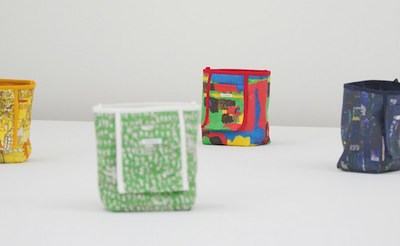

When Photography and Lines Meet: Special Talk Event for the Exhibition "Distant Closeness - Ittetsu Matsuoka and the Universe of Atelier Yamanami" [Part 1]

The exhibition "Close and Far - The Universe of Ittetsu Matsuoka and Atelier Yamanami" was held at HERALBONY LABORATORY GINZA in the fall of 2025.
This exhibition is a collaborative exhibition in which four artists from Yamanami Studio - Yoshida Rikuto , Ino Yuki , Oji Yuya , and NANA - have added drawings to the works of photographer Matsuoka Ittetsu.
Photographer Ittetsu Matsuoka is known for his work, which focuses on fashion and portraiture, carefully capturing the light and temperature that resides within his subjects.
His gaze, which has focused on the "distance" that arises between people, resonated deeply with the expressions woven by the artists of Yamanami Kobo in Shiga Prefecture .
A talk event was held at the venue that day, featuring Matsuoka Ittetsu, Yamanami Kobo facility director Yamashita Kanwa , artists Yoshida Rikuto and Ino Yuki, and Park Rina of Heralbony, who planned the event.
Photography and painting, art and welfare. We talked about the moment when different worlds intersect.
■ How we met and what led to this project

Park Rina (hereafter Park): First, I'd like to ask about what prompted this project. How did you come across Matsuoka-san and Yamanami Kobo in Shiga Prefecture?
Matsuoka Ittetsu (hereinafter Matsuoka): I first visited Yamanami Koubou quite some time ago for a different interview. Since then, we've been talking about how it would be nice to do something together someday. But the opportunity never really came. Then, Mr. Park from HERALBONY asked me, "Would you like to do something together at HERALBONY?" That was the beginning.
Boku: I've always loved Matsuoka's photography. I've always been drawn to his gaze. When I met him for the first time, I felt that not only his work but also his personality might resonate with the world of Atelier Yamanami. I automatically thought, "This meeting was inevitable." But I never thought it would actually come true...it still feels a bit like a dream.
Yamashita Kanwa (hereafter Yamashita): To be honest, when we first heard about the project, we didn't know what to expect. When I heard that we would be "drawing on top of a photograph by a professional photographer," I was a little taken aback. It felt like doodling on a textbook. But Matsuoka-san said, "It's okay, just go ahead and draw." From that point on, it felt like something had loosened up among all of us.
Drawing on a photograph
 "Untitled #1"
Photo by Takumi Kimura (HERALBONY)
Paku: For a photographer, doesn't it take a bit of courage to have someone paint over your own work?
Matsuoka: That's true. But I didn't see them as "artists with disabilities," but as "people who are really good at drawing." So I didn't have any doubts. Rather, I was more excited about how we would fit in together.
Yamashita: From our perspective as staff, the act of "drawing" is an extension of their daily lives. For them, it's more like "play" or "daily routine" than art. So, drawing on Matsuoka's photos wasn't anything special; I think they just felt like, "If it's okay, I'll draw."
Matsuoka: That's really great, isn't it? He just draws, slipping away from all social meaning and evaluation. When I saw what was depicted in my photographs, rather than thinking it was "good" or "beautiful," I thought, "The world looks a little different."
A three-stage process of deepening dialogue

*The large-scale work above is " Untitled #26 ," a drawing by Yoshida Rikuto on a photograph of a "shoe cabinet" that Matsuoka took when he visited Yamanami Studio.
Boku: The production process was divided into three stages.
Matsuoka: At first, I sent the artist dozens of photos I had on hand. From there, I asked the artist to choose a photo they liked and draw it. The second time, I looked at their reaction and reselected photos that "matched well" and sent them over. The third time, I asked the artist to draw freely using photos I had actually taken at Yamanami Studio, as well as some additional photos.
Yamashita: For the larger works, we placed them on the floor, and Yoshida and Ino and I painted them while laughing and sometimes joking around. But when we concentrated, it became quiet all at once. I found those moments very comfortable.
Boku: Rikuto and Ino, how long did it take you to draw?
Yamashita: We usually spend a little over an hour drawing each day. Sometimes we had to stop because we laughed too much (laughs), but that "space" was really good. We got into sync with each other's rhythm, and it felt like the act of drawing itself became a conversation.
The meaning behind the title "Distant Closeness"

Boku: The title of this exhibition, "Far and Near," was thought up and named by Matsuoka-san.
Matsuoka: Even with people who are difficult to communicate with verbally, there are moments when you can understand them through tone or rhythm. I thought that was the "distance of closeness." Even if you don't understand, you're somehow close. That sense of distance is the most trustworthy for me.
Yamashita: I think that's exactly it. The staff working at Yamanami Kobo don't try too hard to "understand" each other. They just live together in the moment, that's all. That's why there's a kindness there that doesn't get too close.
Boku: It's the same for HERALBONY. We value being "felt" rather than "understood." I felt that the phrase "distant closeness" was connected to the core of our activities.
I dare not name it

Boku: In the exhibition, the works are not given titles but are displayed with numbers such as "Untitled #01."
Matsuoka: These works are not just mine, so I didn't want to name them in my own words. I felt that if I gave them names, the meaning would become fixed. That's why I made the exhibition "unnamed."
Yamashita: I think the lack of a title leaves room for each viewer to interpret it differently.
The beauty that comes from letting go
Matsuoka: Perhaps what I learned through this project is the "strength of letting go." Recently, someone I trust told me, "Try floating a little more with more buoyancy." Instead of trying too hard, I thought that if I let go a little, there would be a new view that I could see.
Yamashita: That's exactly it. We have also made it a point to "not interfere" with their expression. I think that trusting them and leaving it to them is the same as supporting them.
Boku: I sensed an air of trust in the work. The white space between the lines and the photograph may be a symbol of the closeness yet distance.
 Towards the end of the event, Matsuoka quietly said,
"This exhibition is probably not finished. It's still in the middle of a dialogue that began when the lines they drew intersected with my photographs. I think it will continue forever."
Photographs and drawings.
Artists and artists.
Welfare and art.
The "closeness yet distance" that was born during that time continues to breathe life into his work today.
(Continued in Part 2 )
>>Click here for a list of exhibited works currently on sale at the official online store
[Exhibition Information]
Exhibition "Close and Far" - Ittetsu Matsuoka and the Universe of Yamanami Kobo -
HERALBONY LABORATORY GINZA Gallery
Date: October 24th (Friday) – November 24th (Monday), 2025
Location: HERALBONY LABORATORY GINZA Gallery (1F Gintomi Building, 2-5-16 Ginza, Chuo-ku, Tokyo)
Business hours: 11:00-19:00
Closed: Tuesdays (or the following day if Tuesday is a public holiday)
Text, composition, and editing: Heralbony Park Rina
Photo courtesy of Karin Noguchi
[Artist introduction]
Rikuto Yoshida
Yuki Ino
Ittetsu Matsuoka


