
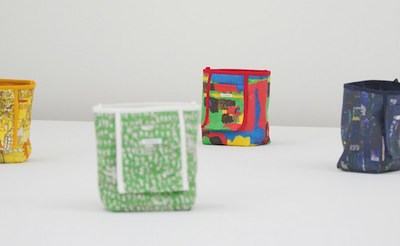

Mika Horii Talk Session: Living as Your Imperfect Self – Part 1

This year, we held a six-day pop-up event at Hankyu Umeda Main Store from June 17th to 22nd. This marks our fourth pop-up event at Hankyu Umeda Main Store since its first launch in 2022.
Hankyu Umeda Main Store, with "WITH Good Harmony" as its store message, actively promotes initiatives that lead to diversity and a better future. This stance deeply resonates with HERALBONY's vision of "bringing unique talents to the center of society and creating new culture." For us, this place is a special stage where the expressions of artists with disabilities can be delivered to many people as art and culture, transcending the framework of "welfare."
This year's theme was "HERALBONY ART PARK." We aimed to create a space where visitors could freely wander and discover and enjoy art from their own perspectives, as if strolling through a park. Through encounters with the artworks, sensibilities are stirred, and values are gradually updated. The cumulative experience of four events is also a testament to our challenge of rooting a "new culture" in society.

On June 20th, during the event period, we welcomed freelance announcer Mika Horii as a guest for a talk event with Takaya Matsuda and Fuminori Matsuda. Under the theme "Living as myself, even if I can't do things 'right'," they discussed living authentically by acknowledging the differences in individual sensibilities and the discomfort with what is considered "normal." This article reports on the event.
"HERALBONY ART PARK" where diverse people gather naturally

Mika Horii is active in podcasts, narration, and recently as an actress. Over 200 guests gathered at the venue, creating an enthusiastic atmosphere. As she had previously participated in HERALBONY's talk sessions, the discussion began in a very enjoyable mood.
Moderator: First, could you tell us about your encounter with Ms. Horii and HERALBONY? It started when Takaya Matsuda, co-representative, appeared on your podcast, didn't it?

Takaya Matsuda (hereafter, Takaya): That's right. The very first time, I was invited as a guest to a program where Mika Horii served as the podcast MC. She showed a lot of interest in HERALBONY then. We're truly grateful that she even purchased some of our products after that.
Mika Horii (hereafter, Horii): I believe it was 2023, so about three years ago. At that time, you were introduced as a startup company that combined welfare and art. In these three years, you've even gone global, which I've been watching with great admiration.
Takaya: Thank you. For us, Hankyu Umeda is always a big challenge, and this is the third event held at the 9th-floor Celebration Square. This year's concept is "HERALBONY ART PARK." We chose a park as our theme, a place where all kinds of people can naturally gather. Do you all notice? The blue carpet underneath is actually a pond in the park. The three tall artworks represent fountains. We're aiming for a park where diverse people can naturally come together.

Horii: It's actually raining today, but being here, I feel like the weather is wonderful! HERALBONY's art displayed here has become something familiar to us, an art we often see now, hasn't it?
Fuminori Matsuda (hereafter, Fuminori): We're delighted to hear you say that. We always strive to create a situation where, the moment people see a work, they recognize it as, "Oh, that's that artist." We'd be happy if events like this provide an opportunity for people to get to know an individual artist.
Horii: Three years ago, when we first met, I think it was a time when you were accumulating energy for your subsequent leap forward. I felt you had a very strong will. I even discussed with my staff that we wanted to convey that sentiment.
Moderator: I heard that you grew to love HERALBONY since then and even purchased a dress yourself.
Horii: That's right. I bought a dress called "Shiawase Pink" by fuco:. During a podcast recording, Takaya and I talked about the importance of properly conveying the value of a product.
Around that time, an acquaintance of mine was selling cookies at a support facility for people with disabilities. They were delicious but sold in a plastic bag for about 50 yen. We talked about how, "If these were sold in Yoyogi-Uehara, they'd sell for 1,000 yen."
The point is that when products are brought to market, it's important to present them in a way that properly conveys their value and ensures they are fairly evaluated. So, I first opened my browser, saw that dress on HERALBONY's official website, thought "It's lovely," and bought it. I wanted to post it on Instagram, but I was worried I might devalue the product by wearing it (laughs).
So, I had a photographer shoot me in the studio, ensuring the dress looked its best, and then I posted those photos on Instagram.
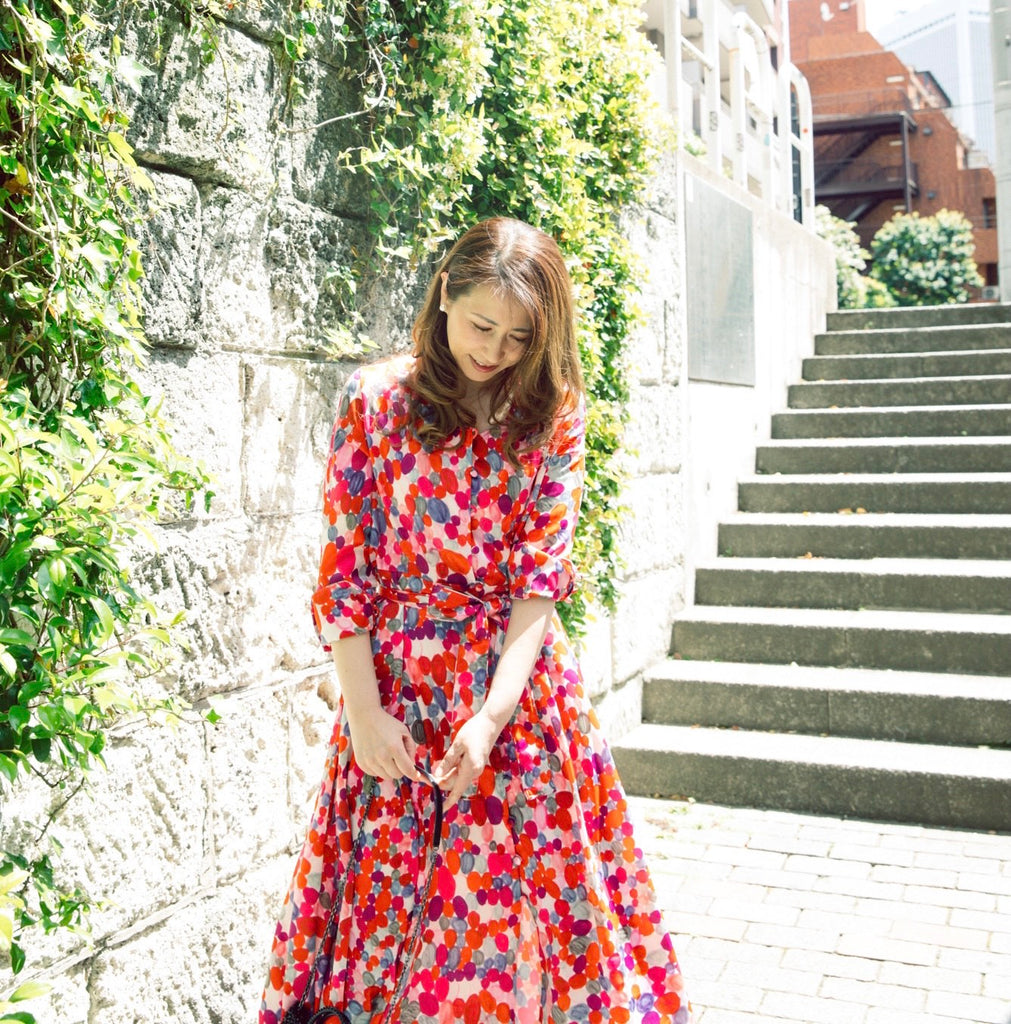
(Photography: Kim Alum)
Moderator: The vivid pink dress suited you very well, Ms. Horii. Before that, as a broadcaster, you often wore clothes with subdued colors and designs, didn't you?
Horii: That's right. Due to my profession as an announcer, I often chose subdued clothes like black or beige, and rarely wore loud patterns. However, fuco:'s dress, with its vibrant colors and round motifs, truly made me feel happy. I intuitively felt brighter just by wearing it.
Click here for fuco:'s artist page >>
Moderator: In terms of wearing such vibrant art, how did your feelings change?
Horii: It was definitely a "Look at me!" moment. Wearing something vibrant makes me feel happy, and I think it probably makes others who see it feel good too. Your outfits today are really wonderful, too. What kind of artwork is this?
Takaya: Thank you. What I'm wearing today is by an artist named Shira Mizukami.


This is the work of an artist from Shiga Prefecture who continuously draws crosses. Recently, her work was adopted for the design of paper cups for JAL's economy class in-flight service. This has led to her literally taking flight, and in various ways, she's an artist who's spreading her wings. Recently, her work was featured in
Click here for Shira Mizukami's works >>
This year, HERALBONY made its debut at Paris Fashion Week, announcing a collaboration with
Horii: That's amazing. I truly believe HERALBONY's presence is reassuring, in its ability to discover such talents, properly turn them into products, and make them assets.
Takaya: Ten years ago, when I was 24, I was working in Tokyo, but I thought, "Someday I want to run a welfare facility" and "I want to start my own business by the time I'm 30 to create a place where my brother can live a rich life." One day, when I returned home to Iwate, I told my mother, "I saw some amazing art drawn by a person with a disability in Tokyo." My mother then asked, "Don't you know there's a place like that in Iwate too?" She recommended I visit the Runbini Museum.
Lumbini Art Museum, Museum of Life
Address: 1-21-29 Hoshigaoka, Hanamaki, Iwate
Opening hours: 10:00 - 15:30
Closed: Wednesdays, Sundays, and the 4th Tuesday of each month
There, I saw works created by people with disabilities for the first time and was profoundly shocked by their overwhelming expression. I was deeply moved. On the other hand, similar to the cookie story earlier, when I searched for "disability art" online, it was often discussed in the context of "they're working hard and it's admirable" or "it's wonderful from a welfare perspective." I felt uncomfortable that the value of the works themselves wasn't being fairly evaluated.
This overlapped with my older brother's experience of being called "pitiful" because he has an intellectual disability. That's why I felt, "If we can completely overturn that notion and deliver wonderful artworks to the world as truly wonderful things, perhaps we can change people's perceptions and values." That conviction was the origin of founding HERALBONY seven years ago.
Horii: Ah, I think many people probably have vague feelings like "I wish it were like this" or "I wonder if it could become like this," but HERALBONY's greatness and your strength lie in giving shape to those feelings, and before you know it, it has become something this significant. Of course, I also feel that behind this are many connections and encounters with many people.
Fuminori: First and foremost, I believe that simply finding the artworks wonderful is incredibly important. Even if everyone thinks so, the way it's communicated and conveyed often labels it as "disability art." The key is how to deliver that flat, direct sentiment without such labeling.
Horii: In the beginning, many people, including us, probably had the impression that HERALBONY equals welfare, in other words, a startup. However, recently, we're seeing HERALBONY's art in more and more places, starting with JAL. In this expansion, do you feel that the public's perception of HERALBONY and art is changing?
Takaya: Perhaps a little more is needed. What we value greatly is that people first feel "cute," "lovely," or "cool," rather than "because it's a work by a person with a disability." People don't choose products just because of SDGs or welfare. That's why we strongly emphasize conveying pure charm first in our store design, website, and visuals.
Simply "buying because it's a good thing" doesn't lead to purchasing behavior. What's important is that the item itself is attractive, that people are drawn to its worldview, and that it excites them. We believe it's crucial to continue creating genuinely good things without compromising on these aspects.
Horii: Public perception has changed quite a bit, hasn't it? Before, I think many people picked up HERALBONY products with the feeling of "I want to support HERALBONY" or "I want to help in some way." But now, there's an inversion happening: "I picked it up because it was lovely, and it turned out to be HERALBONY." I think that change is wonderful.
Pure and special energy resides in free art
Moderator: Were you originally fond of art, Ms. Horii?
Horii: While I'm not an art expert, there was a period in my late 30s when I had a little disposable income. Instead of luxury brands or jewelry, I inexplicably started wanting to buy paintings. I frequented galleries in Kyobashi and Ginza and purchased several pieces. I was afraid my husband would say, "What's this?" when I brought them home (laughs), so I kept the purchased artworks in my locker at the TBS announcer center for a while.

Fuminori: Wow! Amazing. Art in a locker!
Horii: They were all truly small pieces, but about once every six months, in the deserted announcer center on a weekend, it was my secret pleasure to take all the artworks out of my locker, line them up, and air them out. The first piece I really wanted and acquired was by artist Yoko Yamamoto. It was a small piece with delicate line drawings in black, overlaid with a softly depicted landscape, and I was deeply drawn to its world. It wasn't cheap for me at the time, but I took the plunge and purchased the limited edition, signed work.
Moderator: How do you view HERALBONY's art?
Horii: After that, my art journey changed a bit. I spent time at the Rothko Room in the DIC Kawamura Memorial Museum in Chiba, drawn to Mark Rothko's works, and I also visited several exhibitions of New York pop artist James Rizzi, sparked by my son's interest. Rizzi's works, densely packed with many people, animals, and cityscapes, had a mysterious dynamism and the joy of diverse elements coexisting, and I was captivated by that worldview.
When I first saw HERALBONY's works, I was reminded of Rizzi's paintings. And what I felt most of all was a pure energy that seemed to say, "I'm drawing because I want to draw." Rather than meticulous calculations or goal-setting, the brush moved solely on the impulse to create. It is precisely because the works are born from such a process that we receive strength and energy from them, I believe. Art drawn freely, as the artist desires, is what truly resonates with the heart.
Takaya: There are societal values, aren't there? For example, "I want to have a solo exhibition at Hankyu Umeda Main Store" or "I want to sell my work for a high price." There's something truly interesting and exciting about expressions that deviate from that. For instance, marina, a 18-year-old HERALBONY artist with Down syndrome, meticulously fills dozens of notebooks with the same characters. If it were us, we'd inevitably be influenced by society and the market, thinking, "This piece sold well, so let's do something similar next" or "This is what's in demand now." But they are purely "doing it because they want to." In some cases, they don't even consider themselves artists or have any awareness of "creating art."
Click here for marina's artist page >>
That's why I believe there's a special power residing in their pure expressions. And as the ones responsible for delivering those expressions to society, we feel a great responsibility to approach it with dedication.
Fuminori: Indeed, it feels like a true original, something very primitive, and the purity of their desire to create that is tremendously high.
In the latter part, we will continue our discussion on the aspirations and barriers to overcome when venturing into the art world.
▪️Mika Horii Talk Session - Living as I am, even if I'm not perfect. Part 2


